
Chicago bathroom accessibility help finder
Which city, state and veteran programs can actually help with a safer bathroom in Chicago and the suburbs right now, which ones have closed, and where a walk-in tub fits in.
- Real people on the phone
- One-day installation often possible
- DIY drop-ship option
- Helping families since 2012
Get your free Chicago quote
No pressure. No obligation. Just honest answers.

Trust, but verify. We are BBB accredited, and the seal shows our profile. Quotes are free, written and pressure-free.
Short answer
Chicago has no program that buys walk-in tubs. In 2026 the realistic help is MOPD's HomeMod program (roll-in showers and other changes for low-income residents with disabilities, including seniors), Illinois HRAP grants through local nonprofits, VA HISA for veterans, and small grab-bar repairs. Most have waitlists, so apply early and keep a private-pay plan ready.
Why this page exists
Families call us after reading old lists of "free bathroom programs for Chicago seniors." Many of those lists still point to programs that have closed, changed rules or moved to a new office. We checked each official page again on October 22, 2026, and this guide reflects what the agencies themselves say today. Where an agency's own materials disagree, we say so.
We sell and install walk-in tubs and roll-in showers, so we have a stake in this topic. That is exactly why we want you to know when a public program could pay for the work instead. If one fits, apply before you sign anything with any company, us included.
Which Chicago-area program could help me?
Answer six quick questions. The finder runs only in your browser. Nothing you choose is saved or sent anywhere. It gives a starting list, not a decision, because every program checks its own paperwork.
How do the programs compare?
This table summarizes each program's own description as of October 22, 2026. "Bathroom work" means what the agency itself lists, not what we hope it covers.
| Program | Who runs it | Who it serves | Bathroom work listed | Status we found |
|---|---|---|---|---|
| HomeMod | Mayor's Office for People with Disabilities | Low-income Chicago residents with disabilities; no age limit; owners and renters (with landlord approval) | Roll-in showers, accessible sinks, widened doorways | Open with a waitlist; one modification per household per year |
| Home Repair Program | Chicago Department of Housing | Chicago owners up to 50% of area median income | Small accessibility repairs such as grab bars and lever faucets (mainly roofs and porches) | Registration not opening in 2026 |
| SARFS | Formerly Chicago Department of Housing | Formerly Chicago residents 60+ | Formerly grab bars and small repairs | Official page removed; not listed among current programs |
| Home Repair and Accessibility Program (HRAP) | IHDA, through local grantees | Single-family owners at or below 80% of area median income | Accessibility modifications plus health and safety repairs, up to $50,000 | Round 2 grantees named October 2025; long waitlists |
| Home Services Program | Illinois DHS, Division of Rehabilitation Services | People under 60 with severe disabilities | Environmental modifications that offset lost function | Ongoing; apply through DHS |
| Community Care Program | Illinois Department on Aging | 60+, assets of $17,500 or less, enrolled in Medicaid | In-home care; not a remodeling grant | Ongoing |
| VA HISA | U.S. Department of Veterans Affairs | Eligible veterans with a VA prescription | Medically necessary changes such as roll-in showers; lifetime cap $6,800 or $2,000 | Ongoing; approval needed before work |
Program rules change. Confirm with the agency before you plan around any line in this table.
What happened to Chicago's SARFS program?
Small Accessible Repairs for Seniors, usually called SARFS, was the city program most often recommended for free grab bars. As of October 22, 2026, its official chicago.gov page returns a page-not-found error, and SARFS no longer appears in the Department of Housing's list of homeowner programs. Older articles, delegate-agency pages and even some state resource lists still describe it as if it were open.
The Department of Housing's current Home Repair Program page now says the program "will also provide small repairs" such as grab bars and lever faucets for homeowners who need accessibility improvements, with priority based on how long the owner has lived in the home. Income is capped at 50 percent of area median income. The same page says registration will not open in 2026 because of demand, and that people who registered in 2024 and 2025 stay on the waitlist.
Bottom line: if you were waiting on SARFS, call 311 and ask the Department of Housing where your old application stands. If you need grab bars soon, a handyman program, a township program or a private installer is likely faster.
Watch for stale lists. The Illinois DHS home modification resource page still describes SARFS and an older version of HomeMod with an under-60 age limit and a $10,000 cap. The city's own HomeMod FAQ now says there is no age requirement. When two official sources disagree, go with the agency that runs the program.
How does Chicago's HomeMod program work for a bathroom?
HomeMod is run by the Mayor's Office for People with Disabilities (MOPD). It provides accessibility modifications for Chicago residents with disabilities who have low income. The city lists ramps, porch and stair lifts, roll-in showers, widened doorways, accessible sinks and cabinets as typical work. MOPD's own housing page describes replacing traditional bathtubs with roll-in showers as one of its main changes.
A few rules from the program's FAQ matter for bathroom planning:
- No age requirement. The FAQ says it serves people with disabilities and seniors.
- Renters can apply with the landlord's prior approval.
- One modification per household per year for now, so choose the change that matters most.
- About 4 to 6 months on average from application to finished job.
- Standard products only. MOPD handles permits, vendors and inspections at no charge, but it cannot accommodate upgrades in materials or products.
To apply, MOPD asks you to call 312-743-5767 or email MOPDHomeMod@cityofchicago.org before sending the application, because there is a waitlist. Applications need proof of age, disability, household income and building insurance. They are accepted year-round by email or at the Central West Community Center, 2102 W. Ogden Ave.
Source: MOPD HomeMod program page, checked October 22, 2026.
Tub or shower? HomeMod lists roll-in showers, not walk-in tubs. If a walk-in tub is what you want, HomeMod is unlikely to pay for it. Our tub or shower guide helps you decide which really fits the person bathing.
What is Illinois HRAP, and who runs it near Chicago?
The Home Repair and Accessibility Program (HRAP) is funded by the Illinois Housing Development Authority (IHDA) and run by local governments and nonprofits. In its October 30, 2025 announcement, IHDA said eligible homeowners can receive up to $50,000 for health, safety, accessibility and energy repairs. Homeowners must be at or below 80 percent of area median income, current on their mortgage, and own a single-family home that needs work. Accessibility modifications for residents with disabilities or mobility challenges are on the eligible list.
IHDA is blunt about demand: its program page says demand far exceeds funding, most grantees have substantial waitlists, and getting on a list does not guarantee help. You apply through a grantee that serves your area, not through IHDA. Round 2 grantees serving the Chicago area include:
City of Chicago
Rebuilding Together Metro Chicago, and Rogers Park Community Development Corporation (Northside Community Development Center).
Suburban Cook County
North West Housing Partnership (also DuPage, Kane and McHenry), Far South CDC, United Cerebral Palsy Seguin of Greater Chicago, and a South Suburbs Habitat for Humanity affiliate for listed south suburbs.
DuPage, Kane and Kendall
The Neighbor Project (Kane, Kendall and DuPage) and Community Contacts Inc. (Kane).
Will, Lake and McHenry
County of Will, Will County Center for Community Concerns, Will County Habitat for Humanity, Lake-McHenry Habitat for Humanity, and Community Partners for Affordable Housing for listed Lake County towns and Evanston.
IHDA keeps the contact list for every grantee on its revitalization programs page. Note that HRAP is limited to single-family homes, so condo owners and two-flat owners should ask the grantee before applying.
Which Illinois programs apply at my age?
Illinois splits many home services by age 60. That line decides which state agency you call first.
Under 60 with a severe disability
The Illinois Department of Human Services Home Services Program serves people under 60 with severe disabilities who need help with daily living at home. Its services include environmental modifications, which DHS describes as changes that compensate for lost ability, increase safety and reduce dependence on others. A bathroom change can be considered when it fits the person's service plan. DHS's helpline is 1-800-843-6154.
60 or older and needing care
The Illinois Department on Aging's Community Care Program serves people 60 and older with non-exempt assets of $17,500 or less who apply for and, if eligible, enroll in Medicaid. Your home and car are exempt assets. It pays for in-home services and care coordination rather than remodeling, but a care coordinator can point you to local repair help. Call the Senior HelpLine at 1-800-252-8966.
Chicago residents 60 or older
The Department of Family and Support Services is the city's Area Agency on Aging. Its information line, 312-744-4016, can connect you with case management and in-home help. See our Chicago senior resources page for more city and suburban contacts.
Any age, Cook County owner
The Cook County Assessor says its Home Improvement Exemption keeps up to $75,000 of added value off your taxes for up to four years, applied automatically. Seniors 65 and older may also qualify for the Senior Exemption. Details are on the Assessor's exemptions page.
What can Chicago-area veterans get?
The VA's Home Improvements and Structural Alterations (HISA) grant pays for medically necessary home changes, including bathroom access. VA lists a lifetime limit of $6,800 for service-connected needs (or for veterans with a 50 percent or higher service-connected rating) and $2,000 for other eligible veterans. A VA clinician must prescribe the change, and the project has to be approved before work begins.
HISA does not cover spas, hot tubs or jetted bathing, so a roll-in shower is usually the cleaner HISA project. Start with the prosthetics department at your VA medical center. Our parent site explains the full VA HISA process for bathrooms.
Veteran checklist
- Ask your VA provider for a prescription
- Get an itemized written quote
- Wait for VA approval before scheduling
- If you also have a disability and live in Chicago, ask MOPD whether HomeMod can combine with HISA
What if I live in suburban Cook or a collar county?
City programs stop at the Chicago border, but the suburbs have their own layer of help.
Area Agencies on Aging
AgeOptions covers suburban Cook County. AgeGuide Northeastern Illinois covers DuPage, Grundy, Kane, Kankakee, Kendall, Lake, McHenry and Will. Both know which local repair programs currently have money.
North West Housing Partnership
Runs village repair programs in several northwest suburbs, an Older Adult Home Modification Program, and a CAPABLE aging-in-place program for people 60 and older (or adults with disabilities) in Arlington Heights, Buffalo Grove, Mount Prospect, Palatine, Rolling Meadows, Des Plaines, Palatine and Wheeling townships and Oak Park Township. Call 847-969-0561 or see its repair program list.
Townships
Many townships run senior services, equipment lending and handyman lists. Our suburb pages list examples for Arlington Heights, Schaumburg, Oak Park and Orland Park.
HRAP grantees
See the grantee list above. Suburban grantees often have shorter lists than citywide ones, but every grantee checks income and property value.
Will any of these programs pay for a walk-in tub?
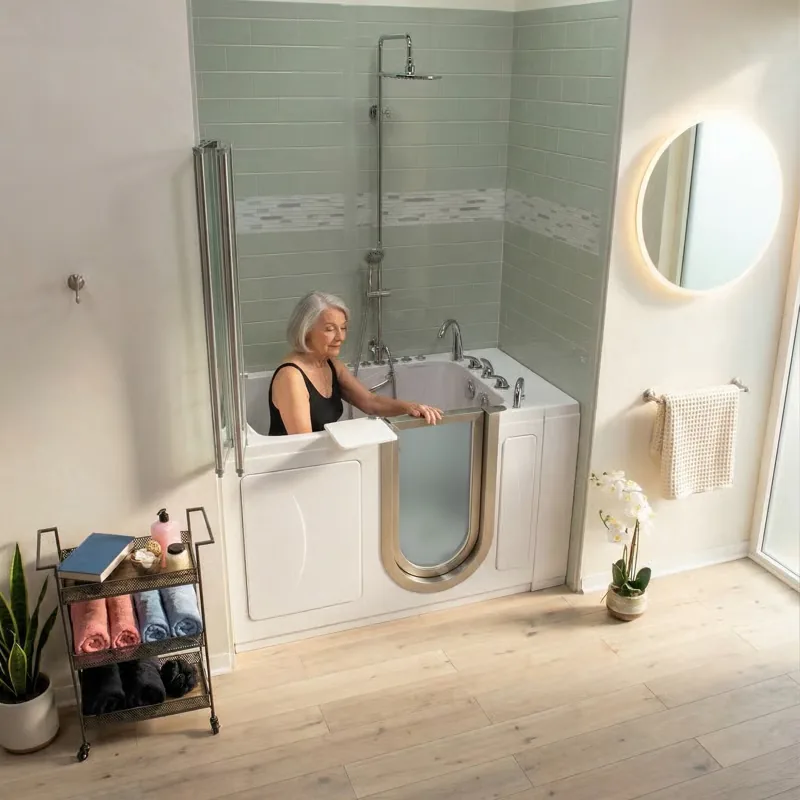
Rarely. The programs above describe roll-in showers, grab bars and small repairs. None of the agencies we checked lists walk-in tubs as standard work, and HomeMod says it cannot accommodate product upgrades. Original Medicare generally does not cover walk-in tubs either.
That does not make a walk-in tub the wrong choice. For someone who wants to sit and soak, has arthritis, or simply prefers a bath, a walk-in tub can be the right fixture even if it is paid for privately. Families often combine savings, help from relatives, a possible medical expense deduction and financing. Our Illinois payment guide and Chicago cost guide walk through that side, and our parent site keeps a national list of walk-in tub grants and programs.
If a roll-in shower is the better fit and you are paying yourself, barrier-free shower kits from Showers4Less can lower the product cost. See the Chicago and Illinois service pages for installation options.
How should I apply without losing my place in line?
Check eligibility first
Use the finder above, then call the one or two programs that fit. Ask whether the list is open and how long the wait is.
Gather documents
Expect to need ID or proof of age, proof of income for everyone in the household, proof of ownership or the landlord's approval, insurance and, for disability programs, proof of disability.
Do not start work early
Programs such as VA HISA require approval before work. Starting first can disqualify the project.
Ask for written quotes
If a program lets you choose a contractor, or you plan to pay the difference, get an itemized written quote.
Plan a bridge
While you wait, a shower chair, handheld shower and properly anchored grab bars can make bathing safer now.
Keep records
Save letters, case numbers and names. If the wait stretches, you will need them to follow up.
Caring for a parent through this? Our caregiver bathing guide covers safer bathing while you wait on a program.
Chicago bathroom help questions
Does Chicago have a free walk-in tub program for seniors?
No. None of the city, state or county programs we checked in October 2026 lists walk-in tubs as standard work. Chicago's HomeMod program lists roll-in showers for low-income residents with disabilities, and other programs cover grab bars and small repairs.
Is Chicago's SARFS program still open?
Its official chicago.gov page now returns a page-not-found error and it is no longer listed among Department of Housing homeowner programs. The Home Repair Program now says it does small accessibility repairs such as grab bars, but registration is not opening in 2026.
Can seniors use Chicago's HomeMod program?
Yes, if they have a disability and qualify on income. MOPD's FAQ says there is no age requirement and that it serves people with disabilities and seniors. The 2026 income limit is $68,050 for one person and $77,800 for two.
Can renters in Chicago get a roll-in shower through HomeMod?
Renters may apply, but the building owner or landlord must approve the modification first. HomeMod is limited to one modification per household per year.
How much can Illinois HRAP pay for home accessibility work?
IHDA says eligible homeowners can receive up to $50,000 for health, safety, accessibility and energy repairs. Owners must be at or below 80 percent of area median income, current on the mortgage, and live in a single-family home. You apply through a local grantee, and most have waitlists.
Can a Chicago veteran use VA HISA for a walk-in tub?
HISA pays for medically necessary changes up to a lifetime limit of $6,800 or $2,000, but it excludes spas and jetted tubs. A roll-in shower is usually the cleaner HISA project. A VA clinician must prescribe it and VA must approve it before work starts.
How long does HomeMod take?
MOPD says the average time from application to finished job is 4 to 6 months, and there is currently a waitlist. Call 312-743-5767 before applying.
Official sources
- MOPD, HomeMod Program (eligibility, FAQ, 2026 income limits): chicago.gov
- MOPD, Accessible Housing: chicago.gov
- Chicago Department of Housing, Home Repair Program: chicago.gov
- Chicago Department of Housing, homeowner programs: chicago.gov
- IHDA, HRAP Round 2 announcement, October 30, 2025: ihda.org (PDF)
- IHDA, revitalization programs and grantee contacts: ihda.org
- Illinois DHS, Home Services Program: dhs.state.il.us
- Illinois DHS, Private and Government Home Modification Resources: dhs.state.il.us
- Illinois Department on Aging, Community Care Program: ilaging.illinois.gov
- Chicago DFSS, Senior Services: chicago.gov
- VA Prosthetics, HISA program: prosthetics.va.gov
- Cook County Assessor, exemptions: cookcountyassessoril.gov
- North West Housing Partnership, repair programs: nwhp.net
Need a written quote for a program?
Itemized quotes for HomeMod, HRAP, VA or private pay. No pressure, ever.